Promer: Automating Template Curation and Library Operations
Building a tool and visual evaluation criteria to support thousands of templates per week, with review by a designer during operation.
- Objective
- Expand Promer’s template library while image sources continued to change and grow.
- Result
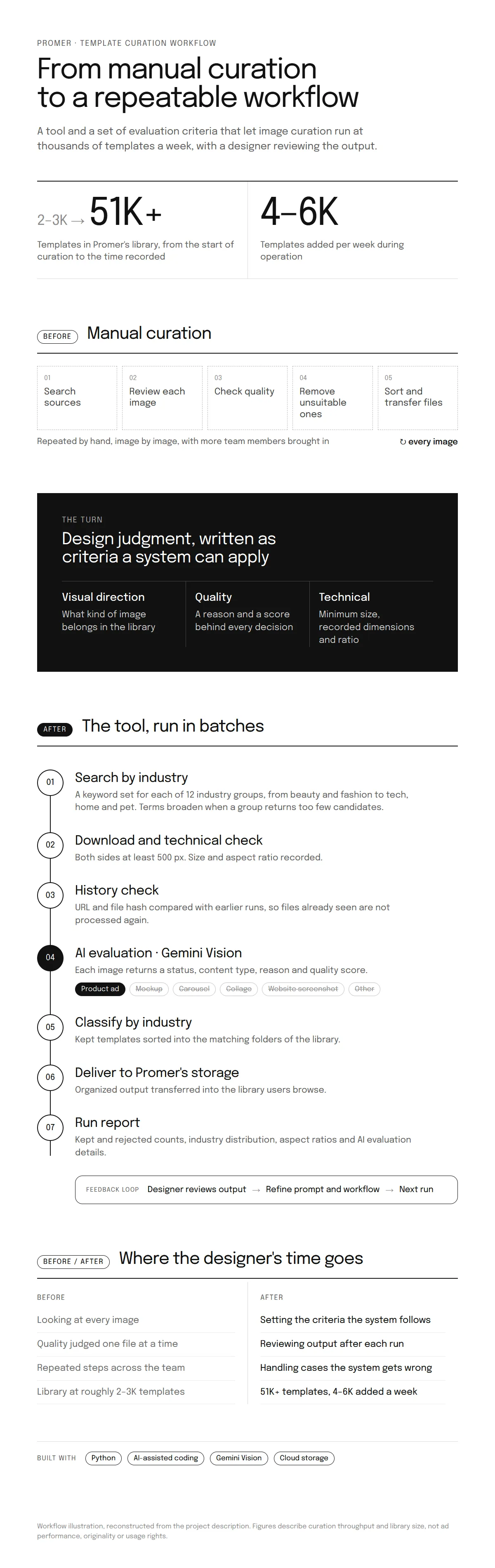
- 4–6K templates per week · library grown from 2–3K to 51K+
- Role
- Define curation criteria; design the workflow; build the tool with AI assistance; review outputs and refine its behavior.
- Responsibilities
- Category-based search, image evaluation, technical checks, duplicate handling, classification, file organization and storage delivery. Tools: Python, AI-assisted coding, Gemini Vision and cloud storage.
4–6K
Templates added per week during operation, based on the working figures I recorded.
51K+
Templates in Promer’s library at the time recorded, up from roughly 2–3K when I began contributing to curation.
These figures describe throughput and library size. They do not measure advertising performance, originality or usage rights for individual templates.
01. When manual curation could no longer keep pace
Promer needed a broad template library so users could find imagery relevant to their industry. When I began contributing to curation, the library held roughly 2–3K templates. Demand for additions kept growing, while new imagery appeared across external sources each day.
I tried selecting images manually and involving other team members. The work involved repeated steps: searching, reviewing individual images, checking quality, removing unsuitable candidates, organizing files and transferring them. As volume grew, this became difficult to sustain through manual work alone.
I began building a local tool with AI assistance, while defining the criteria an image needed to meet before being retained.
02. Turning design judgment into evaluation criteria
The first question was what kind of image the system should look for. An appealing search result was not necessarily a product advertisement suitable for the library.
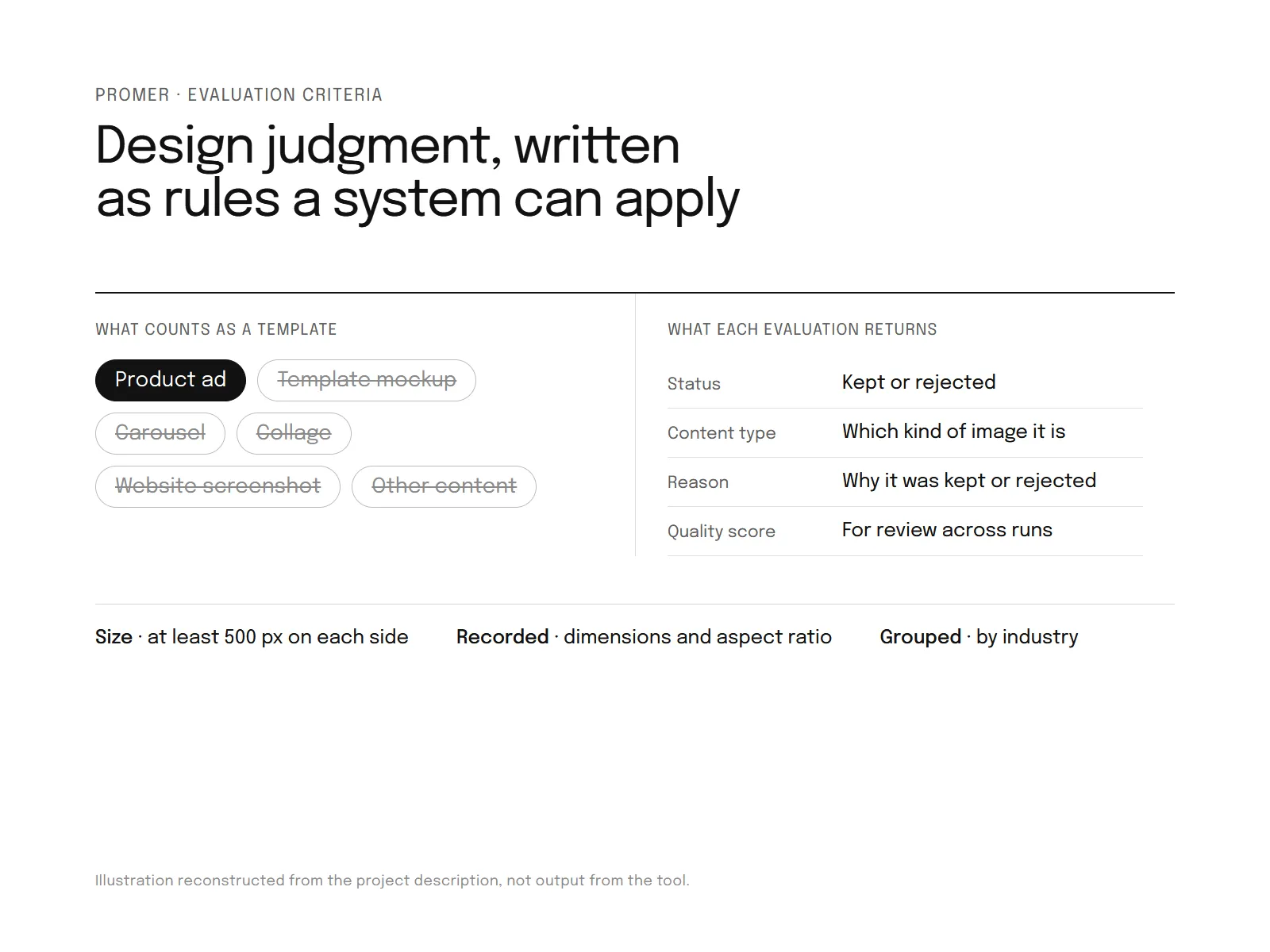
I defined visual direction, quality and technical criteria, then translated them into instructions for AI evaluation. In the documented version, the system was asked to distinguish product ads from template mockups, carousels, collages, website screenshots and other content. Its responses included a reason and a quality score, allowing me to review how selections were made.
Technical requirements were checked separately. This version required both image dimensions to be at least 500 pixels and recorded image size and aspect ratio. These checks supported curation; they did not replace aesthetic review or rights clearance.
03. Building a repeatable workflow
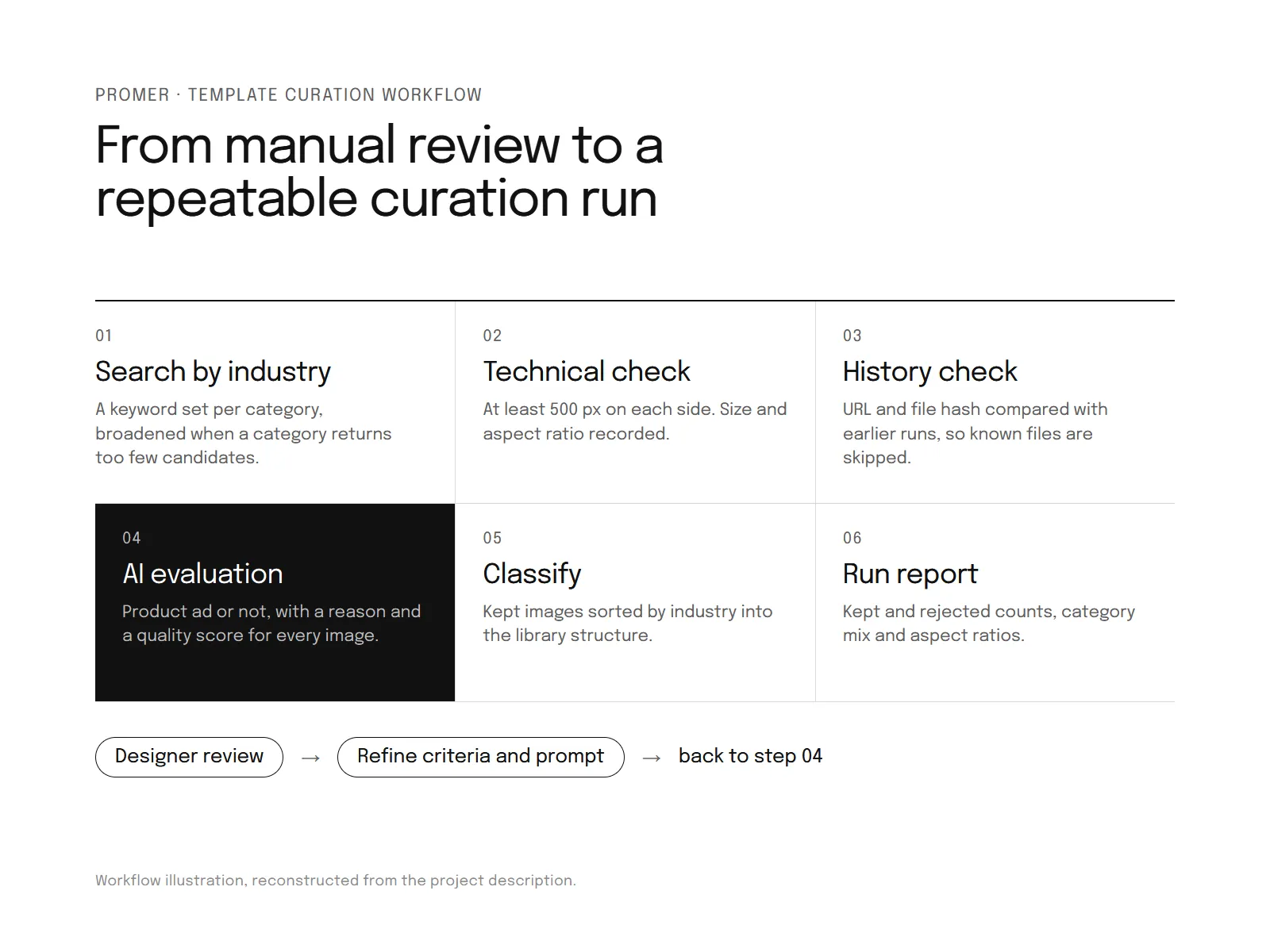
Search was organized by industry, with a set of keywords for each category. The documented version covered 12 industry groups, including beauty, fashion, food, technology, home products and pet supplies. When a category returned too few candidates, the tool broadened its search terms.
After collecting images, the system downloaded files, checked dimensions and consulted processing history before AI evaluation. I added duplicate handling to reduce repeated work and resource use on files already encountered.
This version recorded URLs and file hashes. That supported recognition of previously encountered data, rather than detecting every visually similar image. Resized or reformatted copies could require a different check.
04. Connecting curation, classification and storage
Outputs were classified by industry, placed in the appropriate folders and transferred to Promer’s storage system.
Each run produced a report covering retained and rejected images, category distribution and aspect ratios. The report also recorded AI evaluation information to help me monitor outputs.
05. Reviewing and refining before reducing intervention
During early runs, I reviewed outputs against my own judgment and adjusted the prompt and workflow. Unsuitable selections gave me a basis for further refinement.
As outputs became more consistent, I reduced intervention in individual steps while continuing to scan results after runs. This helped identify deviations that needed attention. It was an operational review, not an independently measured accuracy benchmark, and it did not mean every image had been exhaustively checked.
06. Operational results
During operation, the tool supported approximately 4–6K template additions per week, based on the working figures I recorded. Promer’s library grew to more than 51K templates and continued to receive additions.
My contribution was building the tool, defining curation criteria and connecting the stages into a repeatable workflow. Manual work shifted toward defining standards, reviewing outputs and addressing cases the system did not handle well.
What I learned
Scaling curation required making the criteria clear before assigning more steps to a system. The tool handled volume, while a designer still needed to examine what those standards produced. Visual quality and usage rights required separate consideration.